
Confined Spaces versus Restricted Access
A few subscribers have recently asked me about ‘Confined spaces’. So by popular request, here’s what you need to know…
First, What’s a ‘Confined Space’?
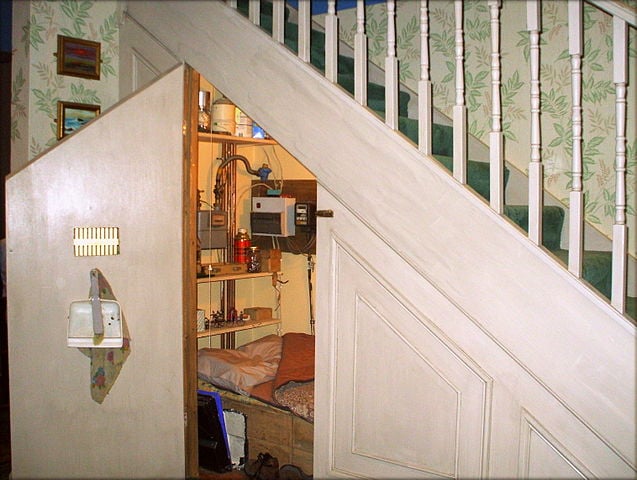
We have a cupboard under the stairs in my house called the “The Harry Potter cupboard”. (In the novel and movie series, Harry grows up at the Dursleys in ‘the cupboard underneath the stairs’.) But is it a confined space?
According to the HSE, a confined space is one that is both enclosed (or largely enclosed) and has a reasonably foreseeable specified risk to workers of:
- fire
- explosion
- loss of consciousness
- asphyxiation
- drowning
In other words, it’s any place that is difficult to get into and out of, and not somewhere to dilly-dally.
My definition is slightly different. My definition of a confined space is anywhere difficult to get into and out of, and somewhere you wouldn’t take your other half for tea unless you want to bump them off. (So arguably confined spaces DO serve a purpose occasionally!)
It’s important to understand that a confined space is not necessarily a ‘small’ space. If you work in your box room at home that isn’t a confined space. Even though it might be small, it’s safe and designed for you to spend time in.
So, what would be a confined space? Well, the Chokey’ in Roald Dahl’s novel Matilda is a confined space! A chimney would also be a confined space. If you’re unfortunate enough to be a Victorian chimney sweep, then you work in confined spaces. Not that the Victorians bothered too much about these things.
As a more modern example, the wings of an airplane are a confined space. As a maintenance engineer you might need to go into the wings, but it’s not a place you would spend any time.
The commercial oven we looked at in my article on Reasonable Foreseeable was a confined space. The oven was difficult to get in and out of, and heat was the main hazard.
An airplane wing or a commercial oven may be large, so size isn’t always the issue with confined spaces. A cooling tower is also a confined space, because it is difficult to get in and out, plus they can contain other hazards such as high or low oxygen levels…
Watch Out for Abnormal Oxygen Levels!
The harder a space is to get into, the more likely it is that the composition of the air will change. This can become quite a big problem.
Many people think that oxygen is a benign gas and that more of it is a good thing. After all, they give premature babies in incubators 100% oxygen through a CPAP machine. What they don’t do however is change the Oxygen concentration of the entire room!
Oxygen makes up 20.8% of the Earth’s atmosphere. (Generally, this is rounded up to 21%.) 78% of the remaining gas is nitrogen, with the other 1% breaking down among other trace gases.
If the oxygen present in a confined space drops, how much of a change do you think the body can withstand?
Well, humans are OK down to around 19.5% oxygen. You might find breathing more laboured, but you’ll be fine within a 1.5% oxygen decrease. You might even be OK down to 17%, especially if you aren’t exerting yourself too much. Below 17% however, you’ll run into significant problems. Below 12% most people will pass out. Below 6% is uninhabitable.
The danger of confined spaces relates to volume. 4% of the Earth’s atmosphere (assuming a drop to 17% oxygen) is a huge volume of gas. 4% of the air in my Harry Potter cupboard under the stairs is not. So asphyxiation is always a potential issue in confined spaces.
On the flip side, if you have too much oxygen you create a potentially explosive environment. At 23% oxygen and above the air itself becomes combustible. Again, in a confined space that could be a small increase in volume.
If you’re working with electrical equipment in a confined space, you’ll need ATEX (ATmosphère EXplosible) rated tools that don’t spark or produce static electricity. Otherwise, as discussed above, if the oxygen levels are high you’ll cause an explosion. There are even specialised handheld tools such as hammers and chisels that don’t create sparks!
Sometimes the issue relates to the contents of a confined space, rather than the space itself. In a sewer for instance you’ll find higher concentrations of methane, which can become combustible too.
In most cases though, oxygen is the big problem. If you’ve ever done first aid training you’ll know that to keep someone breathing you do compressions and then rescue breaths. You exhale around 16% oxygen, which is enough to keep somebody alive who has stopped breathing.
Excavations into a confined space can also cause problems. Even if an excavation is open at the top, if it’s not sufficiently shored up it can collapse, trapping someone underneath. Sometimes you may get an ingress of water you could drown in too.
So What’s ‘Restricted Access’?
A space with restricted access (as opposed to a confined space) would always be somewhere small. If I were to work in my Harry Potter cupboard under the stairs, that would be restricted access.
I’ve disagreed with clients on this in the past. A while back I did some work at a printing company where they have huge printing machines. Under each machine, there’s a walkway and a door to access the controls. The company says this is a confined space, but it isn’t; it’s restricted.
It’s restricted because although it’s small, it is designed for you to go in there and make adjustments. It’s a space designed to be worked in.
So there’s a lot of misinformation around confined spaces. If you’re going to go into a confined space, you need specific confined space training, which usually involves a permit to work. You would need a permit to work because the likelihood of an incident is high, and the consequences are severe. For this reason you can never do loan working in confined spaces. (I’ll discuss permits to work fully in a separate article).
Do you have questions about confined spaces? Did I miss anything? Let me know!
Moira
P.S. To update your training you can browse all our courses at www.safety-now.co.uk.
Tags: